


<img src="//bat.bing.com/action/0?ti=5104607&amp;Ver=2" height="0" width="0" style="display:none; visibility: hidden;">

Advisors & Issuers

image 65

For over 40 years, The Entrust Group has empowered investors to take control of their retirement portfolios with self-directed IRAs. Now, we’re ready to invest in your career. Whether you’re a financial advisor, investment issuer, or other financial professional, explore how SDIRAs can become a powerful asset to grow your business and achieve your professional goals.

Learning Center

Learning-Center-menu-image-1

Access the largest knowledge base for Self-Directed IRAs. Expand your investor knowledge with articles, whitepapers, practical guides and tons of other educational resources.

About Entrust

teg-symbol-about-entrust-menu-image

For over 40 years, The Entrust Group has provided account administration services for self-directed retirement and tax-advantaged plans. Entrust can assist you in purchasing alternative investments with your retirement funds, and administer the buying and selling of assets that are typically unavailable through banks and brokerage firms.

Opening a Self-Directed IRA (SDIRA) allows you to have complete control over your retirement account. However, the flip side of that freedom is that you are solely responsible for whatever occurs within your IRA. Knowing and abiding by the laws that govern IRAs is your responsibility.

Prohibited Transactions

IRS Publication 590 defines a prohibited transaction as any improper use of your IRA by you, your beneficiary, or any disqualified person.

The 4 main categories of prohibited transactions

  1. Sale, exchange or leasing of a property between an IRA and a disqualified person.

    Example: Renting a property owned by your IRA to your child.

  2. Extension of credit or cash loan between an IRA and a disqualified person.

    Example: Using IRA funds to invest in your spouse’s bakery.

  3. Furnishing goods, services, or facilities between an IRA and a disqualified person.

    Example: Personally painting the walls of a condo your IRA owns or hiring your son-in-law to do so.

  4. Transfer of IRA income or assets to, or use by or for the benefit of, a disqualified person.

    Example: Deposit your IRA-owned rental property income to your personal bank account.

light

Not Sure Which Funding Method is Right For You?

If a transaction appears to benefit you beyond the scope of your retirement account, you may want to consult your financial advisor. Violating prohibited transaction rules can jeopardize your IRA’s tax-free or tax-deferred status. Penalties may also apply.

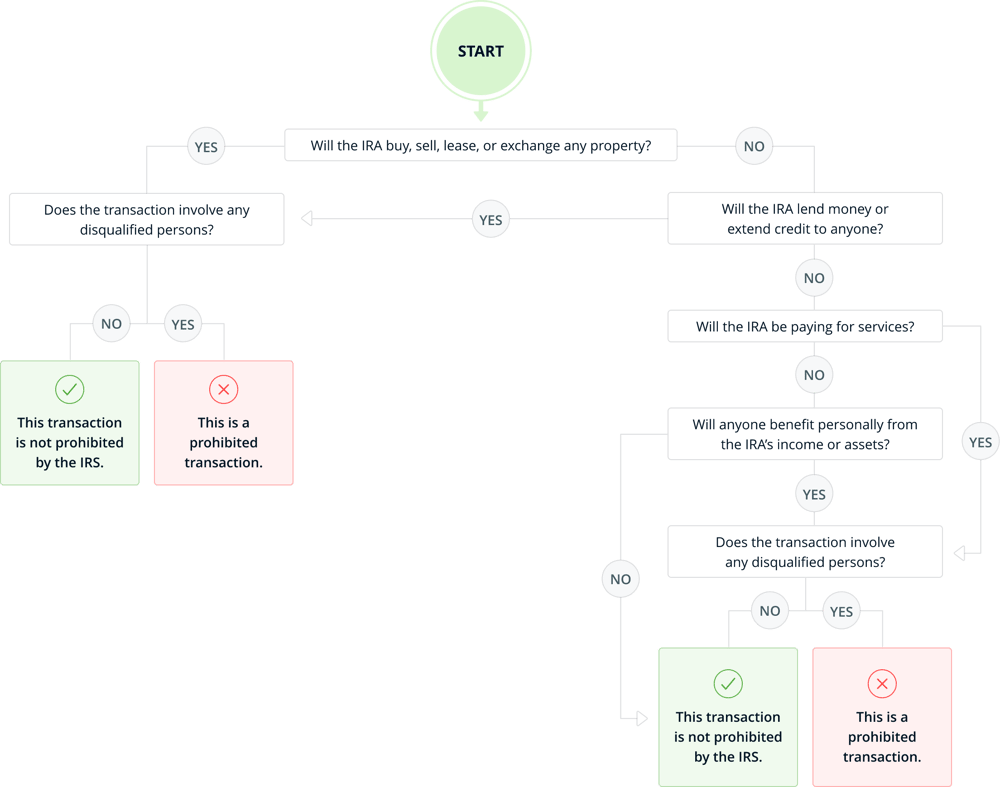
Check out our Prohibited Transaction Flowchart for help assessing potential transactions.

Group 34908@2x


Disclaimer: This chart should not be considered financial advice. Before you make any transaction, be sure to consult with a legal or financial professional

Disqualified Persons

Transacting with a disqualified person can cost your IRA its tax-advantaged status and incur penalties.

Disqualified persons include:

  • You
  • Your spouse
  • Your lineal descendants, ascendants, and their spouses
  • A beneficiary of the IRA
  • Investment advisers and managers
  • Any corporation, partnership (or estate that you have at least a 50% stake in)
  • Your trustee, custodian (or anyone providing services to the IRA)

Investment Restrictions

A Self-Directed IRA’s investment options are practically endless, but they’re not without restriction. There are three types of investments that you are not allowed to invest in with your Self-Directed IRA.
 
The three asset classes not permitted in your IRA are
life-insurance-icon

Life insurance

collectibles-icon

Collectibles

s-corporations-icon

S Corporations

down-arrow

The IRS defines collectibles such as

artworks-icon

Artworks

rugs-icon

Rugs

antiques-icon

Antiques

metals-icon

Metals 1

gems-icon

Gems

stamps-icon

Stamps

coins-icon

Coins 2

alcoholic-beverages-icon

Alcoholic
Beverages

other-dots-icon

Other 3

1 Except for gold, silver, palladium, and platinum bullion of a certain purity.
2 Except for gold and silver coins minted by the US Treasury Department.
3 Certain other tangible personal property.

If you invest in one of these asset classes, the IRA funds in your self-directed IRA will be considered distributed to you as of January 1 of the year you made the investment. You may also be subject to a 10% early distribution penalty if you are under the age of 59 ½.


Now that we’ve established what you can’t invest in, here’s a list of 90 things you can invest in with a Self-Directed IRA. Any investment opportunity that is legally allowed can be held in your SDIRA. If the law allows the investment, your SDIRA can hold it.


Frequently Asked Questions

What are the contribution limits for a self-directed IRA?

Self-directed IRAs follow the same IRS contribution limits as any other IRA, though the specific limit depends on which type of IRA you have:

  • Traditional and Roth IRAs (combined): $7,500 for 2026, or $8,600 if you're age 50 or older
  • SEP IRAs: the lesser of 25% of your compensation or $72,000 for 2026
  • SIMPLE IRAs: $17,000 for 2026, or $21,000 if you're age 50 or older

Because these limits are adjusted annually and can vary by income and plan type, it's worth confirming the current-year figure before contributing.

What is a prohibited transaction in a self-directed IRA?
A prohibited transaction is any transaction between your IRA and a "disqualified person" that the IRS doesn't allow. For example, buying an asset from yourself, selling IRA-owned property to a family member, or lending money between yourself and your IRA. These rules exist under IRC Section 4975, and engaging in one can jeopardize your entire account's tax-advantaged status, not just the transaction itself.
Who is a "disqualified person" for a self-directed IRA?
Disqualified persons include the IRA owner, their spouse, parents and grandparents, children and grandchildren (and their spouses), and any business or entity the owner and other disqualified persons control 50% or more of. Certain fiduciaries and service providers to the IRA also count. Notably, siblings, aunts, uncles, cousins, and friends are not disqualified persons under IRS rules, a common point of confusion.
Can I live in or use property owned by my self-directed IRA?
No. Personal use of an asset owned by your IRA (living in a rental property, staying at a vacation home it owns, even for a single night) is a prohibited transaction under the self-dealing rules. Property held inside an IRA must be used strictly as an investment, not for the owner's or any disqualified person's personal benefit.
What assets are NOT allowed in a self-directed IRA?
The IRS prohibits IRAs from holding life insurance, S-Corps, and collectibles, such as art, rugs, antiques, most coins, gems, stamps, and alcoholic beverages, along with most precious metals except coins and bullion meeting minimum purity standards.
What happens if I break a self-directed IRA rule?
If the IRA owner engages in a prohibited transaction, the IRS treats the entire IRA as if it were distributed as of January 1 of that year, not just the amount involved in the transaction. If any of the funds were pre-tax, that amount becomes taxable income immediately, and if you're under 59½, the standard 10% early withdrawal penalty typically applies on top of that.
What are the RMD rules for a self-directed IRA?
Required Minimum Distributions (RMDs) are mandatory annual withdrawals from tax-deferred IRAs once you reach a certain age. Under SECURE 2.0, that age is 73 for anyone born between 1951 and 1959, and 75 for anyone born in 1960 or later. Your RMD is calculated by dividing your prior year-end account balance by an IRS life-expectancy factor. Missing an RMD triggers a penalty of up to 25% of the amount that should have been withdrawn (reduced to 10% if corrected promptly). Roth IRAs are exempt from RMDs during the original owner's lifetime.